

RECENT POSTS
-
 March 23, 2026
 -
 March 16, 2026
 -
 March 9, 2026
 -
 March 2, 2026
 -
 February 23, 2026
When to Call an HVAC Contractor vs. DIY Repairs
One of the most critical functions in your house, which your HVAC system quietly performs, is to make everything comfortable in terms of sweltering heat or cold. But, just as any other mechanical thing, it requires attention, care, and even repair. The difficult aspect is to know when you can do something and when to get the services of a professional.
Go overboard with DIY, and you may find yourself with even greater issues on your hands, or you may have made your home unsafe. Too fast to hire an attorney, and you may be paying a lot of money that you do not need to. Let's unpack this carefully.
The Sweet Spot: What You Can Do Yourself
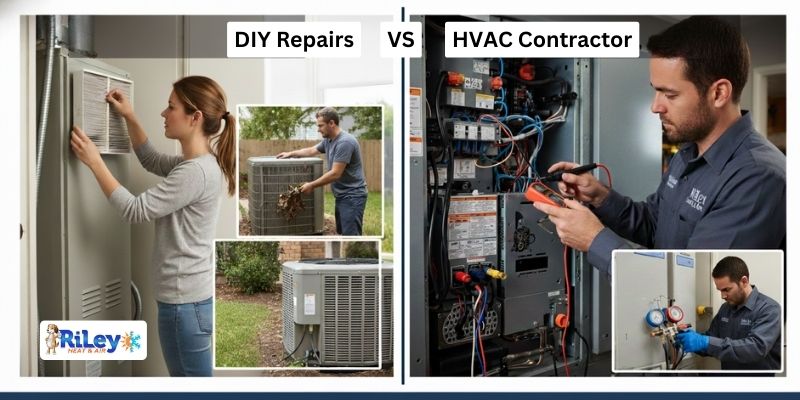
And there are some cost-effective, functional maintenance tasks that you can do yourself. These activities will ensure that your system is efficient and that it does not expose you or your equipment to any risk:
- Replacing or washing of air filters: This is among the most effective habits you can develop, every 1 to 3 months, based on the usage. With a clean filter, air moves through more easily, and your system works less, which also benefits the quality of indoor air.
- Removal of debris around outside units: Any debris, such as leaves, grass clippings, and other items, may obstruct airflow. Lightly cleanse the brush or hose (turn off, then remove debris).
- Vent and register cleaning: Dusting the supply and return vents is a good way to ensure that there is sufficient circulation of air in your home.
- Thermostat testing: Sometimes it is as easy as a wrong setting or a dead thermostat battery.
The tasks can be performed with very few tools and practically no expertise. They aid in avoiding issues emerging, and half the battle is won.
Know Your Limits: When DIY Turns Risky
Not all projects involving an HVAC system are weekend projects. Repair and diagnostic jobs are those with high-risk, complicated technology, legal, and safety implications. This is the place where you ought to pause and contemplate before taking a wrench.
1. Any Electrical Work
HVAC systems operate using high voltages. If you see:
- Burning smells
- Frequent tripped breakers
- Sizzles, buzzes, or pops.
- Elaborated on damaged or frayed wires.
……… that is a warning of electric problems. You do not want to “wing” it on electricity as demonstrated in a YouTube video, or you may get shocked, start a fire, or break the system even more.
2. Refrigerant Problems
Refrigerant is not merely a coolant; it is a controlled chemical. To manage it without the necessary certification is not only risky but, in most cases, illegal. When you can see ice accumulating on lines or your system is not cooling correctly, this is an indication of a refrigerant problem, which requires tools and training from a professional.
3. Strange Noises or Smells
When your system is making grinding, rattling, or hissing noises or you smell something strange coming out of the vents, then it is more than a cosmetic problem. The symptoms mentioned above indicate the problem of faulty motors, electrical issues, or gas furnace malfunctions that most amateur solutions cannot address.
4. Concerns of Gas or Carbon Monoxide.
Also, all the signs of a gas leak or the presence of carbon monoxide are urgent in case you have a gas furnace. Turn it off and get a professional on board. It is not like you can fix these situations through trial and error, but rather for life safety.
5. Recurring Problems
Perhaps you changed the filter or evacuated the debris, and the flow of air remains labored, or the thermostat is yet to respond. When you have done it all, and you can use the simplest means, and the problem has not changed, then it is time to leave it in the hands of one with the tools and knowledge to diagnose the problem.
The Importance of Seeking the Services of a Professional.
When one thinks of an HVAC contractor, calling him may seem expensive. Nonetheless, there are strong arguments why it usually makes good sense and saves you money and stress:
- Safety and Liability: The professional technicians understand how to handle the high-voltage systems, refrigerants, and gas lines without any harm. They are operating on the industry standards and construction codes that keep you and your house safe.
- Correct Diagnosis: This is because it is so simple to diagnose an HVAC problem incorrectly. What appeared to be such a fundamental failure of a part may be a symptom of a more complicated mechanical or electrical issue. Technicians also possess the means and education to seek the root causes, rather than band-aids.
- Warranty Protection: Most HVAC warranties cannot be serviced by anyone other than a professional. Self-repairs are known to cancel that coverage, and you are left to pay a lot for future repairs.
- Long-Term Efficiency: Professionals not only repair the damage but also prevent future damage. They also optimize systems to make them efficient, to reduce your utility bills, and to save on equipment life. HVAC repair by a qualified technician on an annual basis will help to identify minor issues before they turn out to be costly catastrophes.
Balancing DIY and Professional Care
There is no doubt that homeowners can contribute to the proper maintenance of HVAC systems, and one of the proactive measures to ensure the maintenance is low and the comfort high is basic maintenance. However, it is vital to understand when the job shifts to the stage of mere maintenance and when it involves a specialized activity.
Your comfort system constitutes a large portion of the infrastructure of your home. It should be respected and should not be afraid to call the professionals in when the need arises.
Conclusion
Realizing when it is time to bring a professional on board is not about quitting but rather about safeguarding your investment, your health, and your peace of mind. Self-repair may save your finances and allow you to be ahead of minor problems. However, when it comes to technical, risky, or otherwise intractable problems, professional assistance is worth all the cash.
Whether you have big or small HVAC problems, Riley Heat & Air can assist you with that.