

RECENT POSTS
-
 September 22, 2026
 -
 September 15, 2026
 -
 September 8, 2026
 -
 September 1, 2026
 -
 August 24, 2026
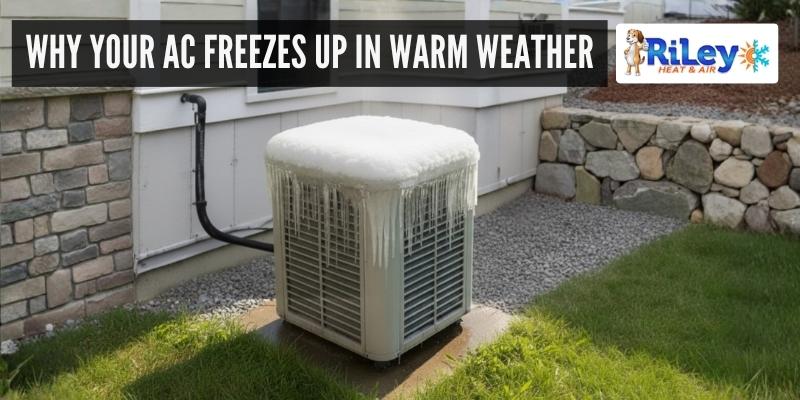
Why Your AC Freezes Up in Warm Weather (Common in Maryland Spring)
The whole thing can be confusing when spring in Maryland begins to get warm, humidity starts to rise, you finally turn on the air conditioning, and it still ices over like it's the middle of winter. It feels backwards. Well, it makes sense when you know what your system is facing behind the scenes.
Let's take it apart.
When “Cooling” Turns into Ice Build-up
ACs are not merely "cold air blowers." They operate by blowing warm air from inside the house over a very cold coil of the evaporator. It is that heat transfer that produces comfort. However, when it is removed from this balance, the coil cools too much. The air is damp, moisture freezes on contact, and you have an ice sheet forming where it is not supposed to be.
That is where many homeowners experience an air conditioner freezing-up issue.
Yes, even on a warm day, it can happen.
1. Poor Airflow Is the Number 1 Culprit
Undoubtedly, the primary cause of most freezing issues is insufficient air circulation. If warm air is unable to circulate through the coil, the temperature becomes below the freezing point. That's when water begins to freeze rather than flow away.
Some of the most common airflow problems include:
- Dirty or clogged air filters
- Blocked or closed vents
- Badly performing blower fans
Most houses in Maryland that have an AC coil freeze usually start off by having something basic wrong with the system. The owner may have forgotten to change the air filter. Not until the freezing starts occurring.
2. Low Refrigerant Levels (Or Small Leaks)
It is the refrigerant that is responsible for removing heat from your home. As levels sink, so do the pressures. The tricky part is that, under low pressure, the coil is too cold. Rather than losing cooling capacity, the system can exceed a threshold, and ice can start to form on the evaporator coil.
This will typically occur in HVAC cases with long-standing ice build-up, particularly in older or poorly maintained systems. No, adding more refrigerant, even if it is a leak, does not solve the problem! It simply puts off the issue.
3. Thermostat Settings That Push the System Too Hard
It might seem like a harmless thing to do, to program the thermostat to “cool faster.” However, the HVAC devices do not perform like that.
This can cause the system to run continuously without adequate heat load over the coil, particularly on cooler nights in the spring when the set temperature is low. That imbalance can cause freezing. Yes, in mild weather, your settings can also be a cause of the air conditioner freezing up.
4. Dirty Evaporator Coils Reduce Heat Transfer
Dust, grime, and build-up on the coil are like insulators. The system does not pass the heat efficiently, and the coil's temperature drops below that.
It is then that moisture freezes and spreads out on the surface. Gradual at first. Then you see weak airflow, or your AC is not cooling ice, something that was not happening the day before.
5. Running the AC During “Cool Enough” Weather
Many are surprised by this one. Spring is an unpredictable time in Maryland with warm afternoons and cool evenings. When outdoor temperatures are already quite warm, the system is not getting enough warm air flowing back through the vents.
Reduced load can cause coil temperatures to drop too low. It is a minor, yet common cause of freezing problems in the spring.
6. Drainage Issues and Trapped Moisture
If the condensate is not allowed to drain properly, the moisture will remain in the vicinity of the coil area. That water is lost from the system in a normal cycle.
However, if this is blocked or partially clogged, it can re-freeze and speed up the ice formation process. This contributes to the accumulation over time and causes increased airflow restriction.
What It Looks Like When Your AC Starts Freezing
In most systems, warning signs leading to a freeze may include:
- Less airflow
- An AC that is running around the clock but not cooling the air
- Ice build-up on the refrigerant lines or coil
- Reduce warm room temperatures even with long cooling times
- Sudden shutdowns or cycling problems
Running the system at this point may make things worse.
Why Spring in Maryland Makes It More Common
Maryland spring weather is a perfect storm:
- High humidity means there is moisture in the air.
- The swings in temperature create system load balance confusion.
- After several months of dormancy, systems turn off to cool down.
- Filters and coils may not have been cleaned and vacuumed since winter.
Even if it is not “broken,” the system is being stressed in a different way than it was designed to handle.
What You Should Do When You Notice Ice
If you think it may be freezing:
- Turn the system off (cooling mode).
- When ice begins to form on the fan, turn it on to “ON” to thaw the ice.
- Wait until it is completely thawed before using it again.
- Inspect filters and vents.
If it freezes again rapidly, then there is a deeper problem, such as a restriction of airflow or a loss of refrigerant. Do not ignore repeated freezing; it can cause long-term problems for the compressor.
Conclusion
There is no such thing as a frozen air conditioner in warm weather, just a system out of balance. Airflow drops and/or refrigerant pressure changes, or moisture can accumulate at a faster rate than it can be removed; ice forms as a result.
The good news is that most of the time, it is possible to prevent a problem through regular maintenance and catching the warning signs early. When the freezing of the AC unit is happening repeatedly, HVAC ice build-up, DC, or cooling problems continue to be a problem, it may be best to have a professional diagnosis to halt the cycle before it causes harm to the system.
Riley Heat & Air is here to help you restore balance, efficiency, and a dependable cooling system before problems grow into significant repairs.
Tags :