

RECENT POSTS
-
 September 22, 2026
 -
 September 15, 2026
 -
 September 8, 2026
 -
 September 1, 2026
 -
 August 24, 2026
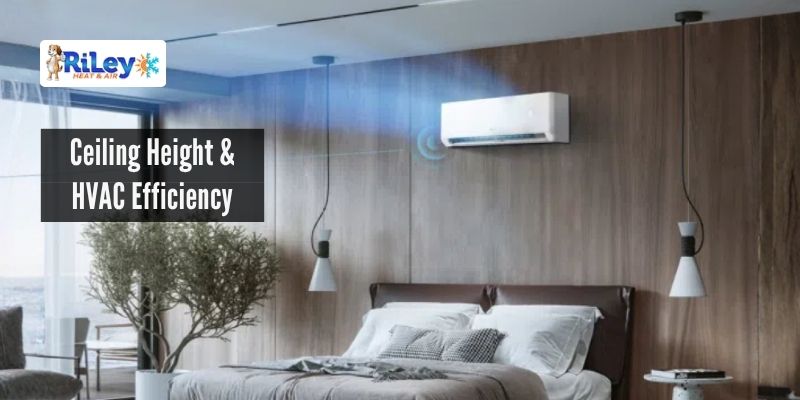
How Ceiling Height Affects Heating and Cooling Efficiency
Have you noticed that one room in your home always seems warmer or cooler than the rest? Ceiling height can be one contributing factor, especially when combined with insulation, airflow, windows, and HVAC system design.
The height of a room influences the volume of air in the room that will need to be conditioned. Houses with high ceilings are homes where the volume of air that requires conditioning tends to be high, but houses with low ceilings will require conditioning of small volumes of air. Understanding this relation is important in making informed decisions concerning HVAC system performance.
Why Ceiling Height Matters for HVAC Efficiency
One of the considerations for sizing an HVAC system is the conditioning space. A room with a higher ceiling contains more air volume, which means the HVAC system has a larger space to condition.
For instance, a 500-square-foot space with:
- 8-foot ceiling = 4,000 cubic feet of air
- 10-foot ceiling = 5,000 cubic feet of air
- 12-foot ceiling = 6,000 cubic feet of air
This extra air volume may make demands for your heating and cooling system greater. However, ceiling height is just one aspect among others that affect HVAC needs.
1. High Ceilings Can Make Heating More Difficult
Warm air tends to rise, which can cause temperature stratification in rooms with high ceilings. Heated air can rise to the ceiling in rooms that have high ceilings and cool air can be present in the lower part of the space.
This can create:
- Cold floors
- Uneven temperatures
- Longer heating cycles
- Increased energy consumption
- Greater thermostat adjustments
An effective HVAC system can help solve these problems. Ceiling fans can also provide air movement by circulating warm air downwards in the wintertime.
2. Cooling High-Ceiling Rooms
The ceiling height is also another variable which influences summer cooling performance, particularly in those houses where there are larger open spaces. The warm air tends to accumulate in the upper space, and it can be far warmer than the space where you can live. At the same time, the heat from the sun coming through large windows or skylights contributes to additional heat gain.
Effective cooling may require:
- Properly sized HVAC equipment
- Adequate supply and return vents
- Good ductwork design
- Ceiling fans
- Proper insulation
- Effective air sealing
Simply installing a larger air conditioner isn't necessarily the answer. An oversized system will cycle too often and will not be as efficient and could impact relative humidity.
3. Ceiling Fans Can Improve Air Distribution
Ceiling fans don't actually lower the temperature of a room, but they can make it feel more comfortable by improving air circulation. In summer, you can use fans to help cool down by blowing air on your skin. In winter, when the fan is on, it can be reversed at a slow setting to warm up the air that collects at the ceiling level.
This can help homeowners to reduce their reliance on the HVL system and keep their home at the desired temperature.
4. Insulation Makes a Major Difference
Insulation is another important factor in how ceiling height relates to HVAC efficiency. If there is no insulation and a high ceiling in a room, heat can transfer to or from the room very quickly, making the HVAC units work a lot harder. A properly insulated attic or roof will lessen the amount of unwanted transfer of heat and help to keep indoor temperatures stable.
Homeowners should also consider:
- Air sealing
- Attic insulation
- Duct insulation
- Energy-efficient windows
- Weather stripping around doors
In some homes, improving the building envelope can provide greater efficiency benefits than modifying the HVAC equipment alone.
5. Don't Ignore Airflow and Ductwork
Without proper distribution of conditioned air, even top-performing HVAC systems can fail. It can be helpful to install supply and return vents in high-ceiling homes that are strategically placed to promote air circulation around the building.
Wrongly designed or inadequate ductwork can cause hot and cold spots and extend the operating time of the system. The thermostat may not be the issue if a particular room in your home is always warm or cold.
Can a High Ceiling Increase Energy Bills?
It can, but the ceiling height is not the only factor in determining energy costs. Homes with high ceilings may use more energy to condition due to having more air volume.
But proper insulation, sizing of the HVAC system, ductwork design, ceiling fans and smart thermostats can make a huge difference. The secret is to design a system that meets the genuine heating and cooling needs of the house.
What Homeowners Should Consider
If you are constructing, remodeling or upgrading a home with high ceilings, consider HVAC requirements early on in the project.
A professional HVAC assessment can assess:
- Room dimensions
- Ceiling height
- Insulation levels
- Window placement
- Air leakage
- Ductwork
- Heating and cooling loads
- Equipment capacity
This will help prevent your system from being too small to serve the demand, or too large as to be useless.
Stay Comfortable with Riley Heat & Air
Although there may be an impact on heating and cooling performance due to ceiling heights, this is only one of the larger HVAC problems that you have to contend with. Your heating and cooling needs depend on the right sizing, airflow, insulation, and design of your HVAC system.
If your house has high ceilings, you always experience hot and cold spots inside your house, or your energy costs are increasing, then we at Riley Heat & Air will look at your HVAC system and show you how you can improve your system's efficiency and performance.