

RECENT POSTS
-
 September 22, 2026
 -
 September 15, 2026
 -
 September 8, 2026
 -
 September 1, 2026
 -
 August 24, 2026
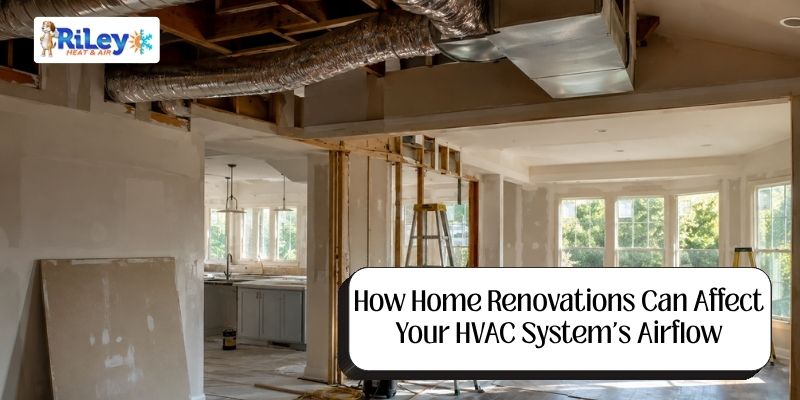
How Home Renovations Can Affect Your HVAC System’s Airflow
A renovation can affect your home, but it may also affect the way air moves throughout your home. You may believe remodeling has nothing to do with your walls, rooms, floors, or finished attic space. But the truth is that these changes can affect ducts, vents, and airflow, making rooms too hot, too cold, or uncomfortable.
Once you understand how renovations can affect your HVAC system, you can take steps to avoid potential airflow problems.
Why Renovations Can Change HVAC Airflow
Your HVAC system was designed based on the layout of your home. Proper airflow through the system depends on ductwork, return and supply vents, insulation, and equipment capacity. However, when you change the layout of your home, the original airflow design may no longer work as intended.
Adding walls can create barriers to airflow, while removing walls can change pressure balance between rooms. A renovation can also involve ducts that are concealed behind walls or ceilings.
The outcome can be:
- Uneven temperatures
- Inadequate ventilation of the vents.
- Longer HVAC operating cycles
- Higher energy bills
- Excessive system cycling
- Increased equipment strain
1. Removing or Adding Walls
One of the most common changes that can affect air movement is a change to the floor plan itself. Large rooms can be divided into smaller rooms, and existing supply vents may no longer provide adequate air distribution. One room may receive too much conditioned air while another does not receive enough.
On the other hand, removing walls can create a larger open area that requires a different airflow pattern. Homeowners should check whether there will be enough properly placed supply and return vents before making changes to the floor plan.
2. Moving or Covering HVAC Vents
New flooring, cabinets, ceilings, or built-in furniture may be included in a renovation project. These changes can accidentally block supply registers or return vents. If a vent is partially blocked, the HVAC system may not be able to maintain the desired temperature and may have to work harder to keep up.
Be sure to keep supply and return vents free from:
- Furniture
- Cabinets
- Rugs
- Curtains
- Decorative coverings
In case a vent needs to be moved, it is recommended that a vent location evaluation be conducted by a professional HVAC technician rather than fitting the vent into the available space.
3. Renovating Attics and Basements
When you complete the attic or basement, it will alter the heating and cooling demands of your house. An unfinished space may have been minimally or unconditioned before its completion. After being converted into a bedroom, office or living space it might need separate heating and cooling.
Insulation can also alter the distribution of heat through the building's envelope. Although there are generally better efficiency gains to be achieved with proper insulation, the HVAC system may require adjustments to ensure balanced airflow to the newly renovated space.
4. Changes to Ductwork
During a renovation, there may be a need to modify ductwork by moving, extending, shortening, or redesigning sections.
Improper ductwork modifications can increase airflow resistance. Poorly sealed connections can also allow conditioned air to escape before it reaches the intended room.
Professional ductwork modifications must take into consideration:
- Duct size
- Air pressure
- Airflow requirements
- Insulation
- Sealing
- Existing system capacity
It is not always adequate to simply add a duct to an existing branch to accommodate the desired airflow into a new room.
5. New Windows and Doors Can Change Heating and Cooling Loads
Window and exterior door replacements are popular home renovations. Energy-efficient replacements can help reduce heat transfer and improve efficiency. However, the heating and cooling load can also change if the size, location, or number of windows is changed.
For instance, new large windows can add to solar gain in the summer. A room with greater exposure to the outside, for example, may thus have different cooling requirements than before. The HVAC professional will be able to assess these changes and see if adjustments to the air and equipment are needed.
6. Open-Concept Renovations Need Careful Planning
While an open-concept layout offers benefits such as more space and natural light, it can also alter air circulation. Air may flow differently through the house when interior walls are removed. Return air paths may no longer function as designed, potentially leading to pressure imbalances.
Homeowners should have an HVAC layout reviewed before removing walls. This is especially critical if ductwork, return air systems, electrical or other building systems are in the wall.
Renovations Are a Good Time to Review HVAC Performance
If the building is being renovated, then it is a great time to have an overall look at the HVAC system.
Have a pro check it out:
- The movement of air into and out of the area
- Ductwork condition
- Equipment capacity
- Thermostat location
- Insulation
- Vent placement
- Indoor humidity
- Air filtration
In addition, existing HVAC systems might have to be assessed again if the renovation process will result in expanding the air-conditioned space considerably. There is a system designed for each individual room to ensure that proper comfort levels are maintained without wasting energy.
Keep Your Renovation Comfortable with Riley Heat & Air
Your goal is to make your house look beautiful without creating additional comfort concerns. Changes to walls, room layouts, insulation, windows, and ductwork can all influence the efficiency and effectiveness of your HVAC system, so proper planning is important.
If you're considering a major renovation, consult an HVAC professional early in the process. Riley Heat & Air can provide a comprehensive evaluation of airflow, ductwork, equipment efficiency, and heating and cooling needs to help keep your home comfortable year-round.