

RECENT POSTS
-
 September 15, 2026
 -
 September 8, 2026
 -
 September 1, 2026
 -
 August 24, 2026
 -
 August 17, 2026
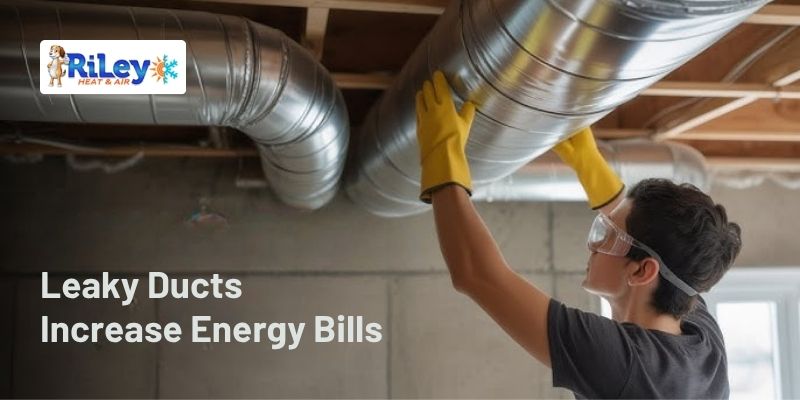
How Leaky Ducts Increase Energy Bills
Leaky ducts usually go unnoticed as they do not make themselves known easily. No dramatic failure. There is no preceding influence or indication. A gradual yet bitter loss of efficiency and your money. To understand it better, you need to fully understand the role it plays.
Understanding the Role of Ductwork in Your HVAC System
Ducts are a component of your heating and cooling system that deliver the air. They bring conditioned air from the furnace or air conditioner to each room in an attempt to provide the same level of comfort in every room.
That process is efficient and predictable when all the parts are properly sealed. However, if there are gaps, cracks, loose joints, or disconnected sections, the system will cease to function properly. A part of this air goes into the unconditioned spaces, like attics, crawl spaces, garages, or wall cavities.
Where The Energy Actually Goes
Any duct leakage is a lost cost of energy. When ducts leak, some of the conditioned air will not get where it is supposed to go. Rather, it simply diffuses out into areas where it is not intended to be temperature-controlled.
Cooled air, for instance, can be lost to an attic during the summer when the temperatures can be very high. This is the same during the winter when warm air escapes from the structure to the cold space. Duct leakage is one of the largest hidden energy inefficiencies in residential buildings and can represent approximately 25% of the total HVAC energy loss in many homes.
Why Leaky Ducts Drive Energy Bills Higher
The easiest effect of duct leakage is simply longer run times. If the conditioned air is not reaching its destination, then there is an issue. The HVAC system keeps going, using more power to make up for the loss.
This produces a chain effect, which is as follows:
1. Longer operational time
The running time will be increased in order to attain the required temperature with higher usage of electricity.
2. Overloading of systems
All of these contribute towards overworking the fan, compressor, and heat exchanger in order to attain satisfaction.
3. Repeated energy loss loop
The more air leaks it allows, the more effort the system will have to make in order to produce.
Research indicates sealing ductwork can save heating and cooling energy in many homes by 10%–20% and more, just by stopping the loss cycle.
The Hidden Cost Of “Invisible” Air Loss
Duct leakage is not an issue that prevents the system from operating; it is merely an issue that causes the system to work less efficiently.
Even if a house is “okay” overall, there is the possibility that:
- Some rooms will not get to the correct temperature
- The HVAC unit operates more often.
- The rates for utility services gradually increase.
- Comfort becomes inconsistent
Practically, even a dribble of water is like a hole in a water pipe; it is not a big deal at first, but it definitely adds up.
Plus, the ducts can be hidden in places that you do not use much, such as crawl spaces, basements, and attics, and this can go on for years without you realizing it.
Added Strain on HVAC Equipment
There is a lot more involved than energy bills.
Leaky ducts cause the HVAC system to consume more energy and incur more wear.
Because the system runs for a longer period of time and cycles more often:
- Motors work harder
- Compressors are subjected to higher stress loads.
Because components age faster than normal, they can cause the fluorescence to decay more quickly. This can result in increased frequency of repairs and a shorter life for the system.
The cost does not end at monthly utility bills; it can also manifest itself in the replacement of the system in the near future and increased maintenance costs.
Why Insulation and Location Matter
Leaky ducts are an issue when they pass through unconditioned areas, particularly when the area is humidified. Unconditioned areas are problematic when a leaky duct passes through.
Any air that leaks out of attics and crawl spaces will be lost to the outside, where temperatures can be either hot or cold. In addition, poorly insulated ducts can also lose or gain heat from the walls without a leak, also reducing efficiency. This double penalty is the result of the combination of air leakage and thermal loss.
Indoor Air Quality Can Also Be Affected
The primary focus on energy efficiency does not end there. Leaks can also draw air from other areas around the duct when the duct is under pressure. This means that dust, insulation, and particles of other materials from the attic or crawl space can blow into the airflow and be circulated in the building.
This is not only a waste of energy, but it also has an impact on air quality and comfort.
Why Small Leaks Become Big Bills Over Time
The reason why leakages are so expensive in terms of costs incurred by the duct is because of the process of buildup. The existence of one small hole may not be very serious. However, there are usually several holes in a duct.
Over months and years, this leads to:
- Gradually increasing energy bills
- Reduced HVAC efficiency
- Greater strain on equipment
- Uneven home comfort
It rarely happens overnight. It builds quietly.
Addressing The Problem Early Makes a Difference
On the bright side, duct leaks are among the most easily corrected problems associated with HVAC systems. Proper duct sealing and insulation can save on energy consumption. Even small fixes can make for major differences in how much energy is used.
A tighter duct system also translates into more comfortable home temperatures.
Conclusion
Leaky ductwork may be quiet, but its effect is constant and persistent. It causes extra stress on HVAC systems, raises monthly expenses on electricity, and slowly but steadily decreases the level of comfort in the household. It is not because this problem is complicated; rather, it is because it remains unnoticed. Once spotted, however, it becomes one of the best chances for improving the efficiency of the household.
When you wish to understand the efficiency of your HVAC systems, or just wish to save on unnecessary expenses, a professional examination can become the best starting point. This is what Riley Heat & Air is dedicated to doing today.
Tags :