

RECENT POSTS
-
 September 22, 2026
 -
 September 15, 2026
 -
 September 8, 2026
 -
 September 1, 2026
 -
 August 24, 2026
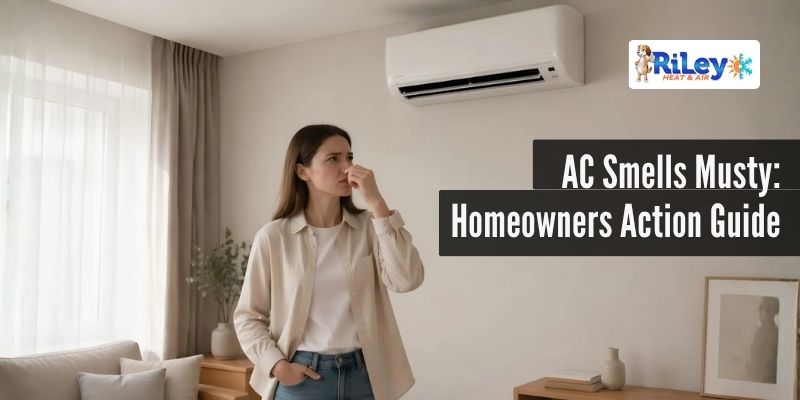
Why Your AC Smells Musty in Spring: What DC & Maryland Homeowners Should Do Immediately
Every spring, there is a familiar time for many DC and Maryland homeowners. The temperature rises, you turn the air conditioner on, and you are exposed to a damp, earthy odor that is not suitable for your home. It is not subtle either.
Sometimes it seems like a wet basement has seeped into your vents. Sometimes it is more like old gym stockings in a forgotten corner. In any case, it is a terrible smell, which is typically an indicator that something was going on within your HVAC system during the dormant winter season.
There is a reason for that smell. It also does not self-stabilize very often.
What That Musty AC Smell Actually Means
If an air conditioner releases a stale or ‘wet' odor, it is most likely related to moisture that has not thoroughly evaporated from the system. When air conditioners are cooling, they are bound to generate condensation. The water should flow freely through the condensate line. Yet, when it remains stagnant, particularly during the off-season, it becomes a possibility for microbial growth.
Simply put, if you have got moisture, darkness, and dust, you have got odor. This combination can cause the formation of mold or mildew on the inside surfaces, such as the evaporator coil or drain pan. With the resumption of airflow, those particles and gases are pushed directly into your living space.
If you are smelling an air conditioner smell that you see most homeowners in DC report during the spring, then you are not seeing it in your imagination. You are only smelling what developed during the idle time of the system.
Why Spring Makes the Problem Worse in DC & Maryland Homes
Spring is the perfect storm for HVAC odors in this region. Temperatures change, humidity begins to increase, and systems are frequently restarted after months of being dormant. In that "downtime," there is a bit of moisture trapped that does not evaporate as it should. These, however, remain in silent residence in coil and ductwork and in drain pans.
During system start-up, air is forced over the damp surfaces. The stench is detected when it is, sometimes right away, sometimes after several minutes of jogging. Yes, it is not an old AC smell. This is typically the beginning of biological film build-up within the unit.
The Most Common Causes Behind HVAC Mold Smell
If your system smells off, there are a few usual suspects. Most of them end up returning to the topic of moisture.
1. Mold or Mildew on the Evaporator Coil
This represents the most usual source. The evaporator coil remains cold all the time and constantly has to cope with condensation. This can create a breeding ground for microbes that emit odor in your vents if dust and moisture mix.
2. A Clogged or Stagnant Drain Line
Your AC has a small drain line that takes water away. When it is only partially obstructed, water backs up and pools in the system. The standing moisture starts to be a significant factor in HVAC mold smell complaints.
3. Dirty Air Filters Restricting Airflow
A dirty filter will not only diminish cooling efficiency, but it will also have a negative impact on other air quality issues. It can retain moisture and organic material, providing conditions for the growth of odor-producing agents.
4. Damp Ductwork or Insulation
Ductwork insulation can trap moisture in some homes, particularly older homes in DC and Maryland. After the initial cause is removed, odors can remain for long periods.
5. Residual Winter Moisture
During colder seasons, when systems are not in use, a little of the trapped water will not always evaporate completely. If the cooling continues, then that “stale air pocket” is released at one time.
What Homeowners Should Do Immediately
If your AC is smelly, do not suppress the smell or ignore it, or use air fresheners to mask it. This suppresses the symptom, not the cause.
Real solutions for helping:
- Run the System Briefly and Observe: Turn on the air conditioning and run it for about 10-15 minutes. If the smell disappears quickly, the water could be leaking out. If it gets worse, then you likely have an accumulation within the system.
- Replace The Air Filter Right Away: Very simple and often forgotten. A clean filter enhances airflow and decreases the moisture build-up inside the filter.
- Check for Drainage Issues: A red flag is if there is puddling around the indoor unit or if there is slow drainage. A clogged condensate line is a quick way to an ongoing odor problem.
- Look at Ventilation Holes for Imbalance or Focusing of the Odor: If one room is smelling more than the others, you’re looking at local contamination in your duct system.
- Do Not Delay Professional Cleaning If the Smell Persists: Persistent odors typically indicate a problem within coils or ducts. Simple homeowner repairs at that point will not be enough.
When It Is More Than Just a Smell Problem
A musty odor is not just a comfort issue. It can also indicate that the building is inefficient and that indoor air quality is bad.
When not properly maintained, mold or mildew in an HVAC system can:
- Disperses spores by wind.
- Reduce cooling performance
- Increase energy consumption
- May cause allergies or respiratory irritation
That is why regular AC mildew issues are something that should never be ignored, particularly if they come back after filter replacement or temporary fixes.
Conclusion
That musty smell coming from your vents is not random, and it is not something homeowners in DC and Maryland have to live with every spring. It is usually a sign that moisture has been sitting inside the system long enough to create microbial build-up. The good news is that early action makes a big difference. Most issues can be corrected quickly if addressed before they spread deeper into coils or ductwork.
If you are a homeowner struggling with persistent smells from your air conditioning system or have any issues with your HVAC system that arise again and again, contact Riley Heat & Air for expert inspection, cleaning, and maintenance services.
Tags :